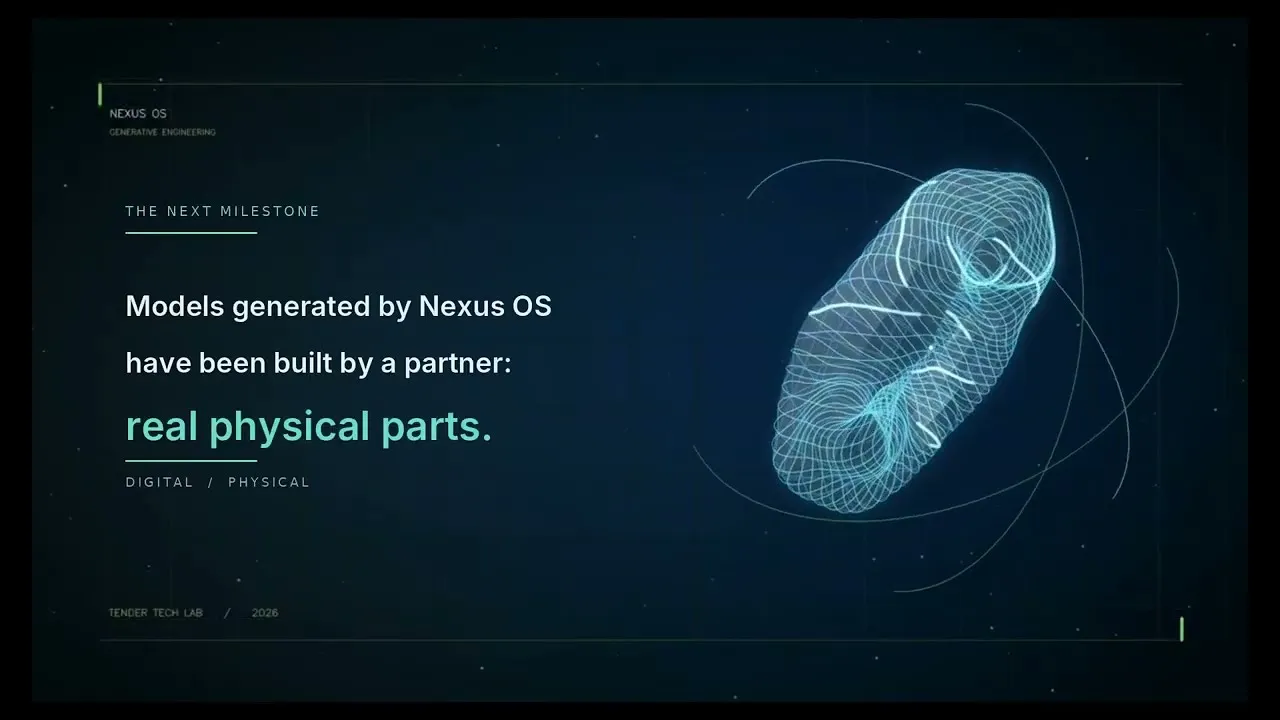
Load doubles, bracket recomputes
DoneLoad caseClick to recompute live
Volume55.18cm³+29.8%
The load doubles to 1,200 N, the geometry is recomputed, and the volume grows by 29.8%.
Graphics acceleration unavailable // the 3D background is shown as a still image, all content is intact
Deterministic physical AI for manufacturing
USPTO Patent Pending U.S. provisional application filed
Generative AI guesses at shapes. Nexus OS doesn’t. You write the engineering spec in one sentence, a language model reads it, and physics and maths work out every millimetre of the part. The model draws no vertices, so the file is ready for the printer on day one.
Parts computed from physics and checked before export
< 1day
Target for one round on a custom part, including engineer review and excluding printing and testing. The traditional route takes about 14–21 working days (team estimate).
72ops
deterministic operations: 38 basic geometry and 34 standard parts
50+principles
of physics and mathematics, already written into the system
< 1day
Nexus OS
Target: under 1 day. Tens of seconds to compute the geometry, plus engineer review
RedrawingDesigning
Time for the design itself
“With custom hardware, whoever ships a qualified sample first wins the supply-chain order. Engineers should be setting the spec, not staying up late fixing broken CAD faces.”
Five steps, from one sentence to a file ready to slice or import
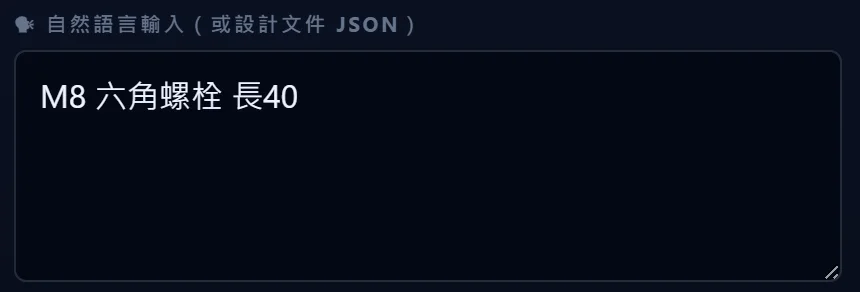
Type it the way you’d say it, for example “M8 hex bolt, 40 mm”
Size, volume, mass and pressure drop are checked before anything is shown
Open the shell in mid-air to see the cooling channels. Grab a local snapshot to adjust one area without redrawing
STEP, STL and 3MF, each locked with a SHA-256 fingerprint
Send it straight to the metal printer or CNC machine on your floor
From a formula on the screen to a file you can print or machine
01
Type it the way you would say it, as in the screenshot: M8 六角螺栓 長40, an M8 hex bolt, 40 mm long.
02
Once the part is generated, the system measures its size, volume and weight. All 3 checks pass and the screen shows "verification passed".
Bounding box about 15 × 13 × 45.3 mm, volume about 2,786 mm³, mass about 21.9 g (steel, AISI 1018), surface area about 1,537 mm².
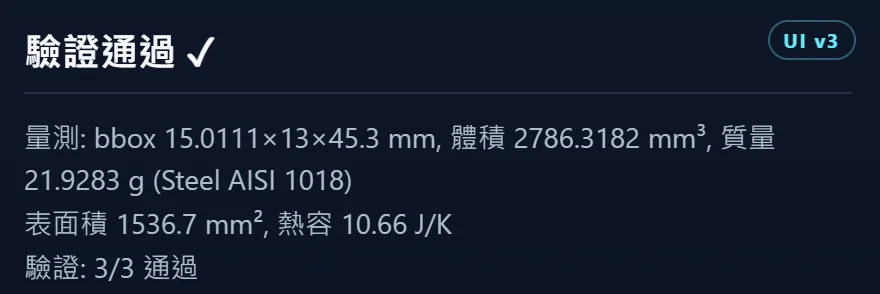
These are screens from the current Nexus OS interface. The screenshots show the interface in Traditional Chinese.
03
No mouse needed. Turn the model and zoom in with both hands, then open the shell like a door to see the water channels inside, and decide on the spot whether to adjust.
Gestures are an optional feature that uses a camera, and the interface also has section and see-through tools. Existing STL files can be imported too, and turned or zoomed the same way.
Schematic animation, not a screen recording
04
Export the format you need.
A part that fails its checks is not exported, and every file carries a SHA-256 fingerprint.
05
Send the file to a printer or a machine and you are holding the part.
Nexus OS prepares and checks a file that can be made. Printing and machining happen on your own equipment or at your manufacturer.
This sample is printed in clear material instead of metal, so you can see the channels inside.
Computer time to produce the part. Excludes printing and physical testing.
Time from one sentence to a partInternal test
02Recompute
In parametric CAD, moving a mounting hole 2 mm can break the whole feature tree. In Nexus OS, double a bracket’s load from 60 kg to 120 kg, or move a hot spot, and the whole part is recomputed in tens of seconds.
Load caseClick to recompute live
Volume55.18cm³+29.8%
The load doubles to 1,200 N, the geometry is recomputed, and the volume grows by 29.8%.
Hot spot positionClick to recompute live
Split point shift0mmBaseline
The hot spot is at its original position (40%), so the water path stays as it was.
Try it: pick an option and the 3D part in the background recomputes (illustration). Switch to X-Ray mode to see the hot spot change.
03Verify
01
It draws no geometry vertices. All geometry is computed by code from formulas.
02
The same brief and settings give the same part, and every step leaves a SHA-256 record.
03
The system tells you which check failed, and nothing is delivered until the conditions are met.
Pressure-drop limitClick to recompute live
Channel depth1.6mm+0.4 mm
In the aerospike cooling-channel case, the limit tightens to 200 Pa, the channel deepens to 1.6 mm, and the computed drop is 199.96 Pa, 0.04 Pa under the limit.
Try it: tighten the pressure-drop limit from 500 Pa to 200 Pa and the flow channel is recomputed.
These three things are already built into Nexus OS.
Confirm first
If the language model adds a value that is not in your request, the system flags it. An engineer reviews and confirms the requirement card before any geometry is computed.
Own data
Before the result of a run is kept for learning, names, images and file paths are removed.
One workstation
Parts for metal printing are computed on a single workstation, without cloud computing. The system also checks that channel openings connect to the outside.
Rocket engine combustion
Computes the products and temperature of burning propellant, and designs the cooling channel of an aerospike rocket nozzle.
Semiconductor gas delivery
Designs a gas distribution block that balances the flow to its outlets.
Both are research cases built with the same engine.
Technical details are available on request: team@tendertech2018.com
04Modes
Operating mode
For engineers
Parts that go onto machines
Brackets, water paths, equipment parts
For designers
Shapes and creative work
Mugs, figurines, charms
05Security
Built by security engineers who have worked on TSMC production lines. Nexus OS runs on your own workstations or a private 5G network, and the service listens only on 127.0.0.1. It makes no cloud API calls. Every part you approve stays on site and trains a model that belongs to your factory, so what your senior engineers know stays with the company.
What the software does today
Local only
The web libraries are bundled, so no internet connection is needed.
Model on this machine
Nothing is sent to a cloud AI service.
Fingerprint check
If a fingerprint does not match or a check fails, nothing is delivered.
27.7%
Share of the security incidents handled by IBM X-Force that hit manufacturing, the top sector five years in a row
IBM X-Force Threat Intelligence Index 2026 (2025 data)
All of them need many custom parts, and change them quickly
Every process shrink means new jigs, fixtures and gas distribution blocks, and they have to be precise and fast to turn around.
Rack power has gone from 8 kW to 600 kW with full liquid cooling. Each generation needs new cold plates and manifolds, worked out for low pressure drop and less pump power.
A humanoid robot has more than 10,000 parts, over 60% of them custom, including 28 bespoke structural actuators. Part counts keep climbing. Engineering teams don’t.
Options
100×
More options in the same time
Comparison
50designs
Alternatives compared in one day
Time
95–99%
Design time saved
06Next
A desktop-projection workbench for engineers, in development.
IN DEVELOPMENT
1:1 millimetre desktop projection, automatic avoidance of physical parts, and recomputing with your hands in mid-air.
The investor deck, 10 pages.
Parts computed from physics and checked before export
Tender Tech Labs
Nexus OS is part-design software from Tender Tech Labs Limited. You describe the part in one sentence. The language model only reads the conditions. Dimensions and shapes are computed by code from physics and mathematics, and the system checks them itself before delivery.
Many generative 3D tools produce a shape from a learned model. In Nexus OS the language model draws no geometry vertices. All geometry is computed by code from formulas, so the same brief and settings give the same part, and every step leaves a SHA-256 record.
It stops. If wall thickness, watertightness or pressure drop fails, the system tells you which one. Nothing is delivered until the conditions are met.
Not in the current design. Drawings, requirements and records stay on your own computer or the customer’s internal network. The service listens only on the local address, and the language model runs on the same computer instead of calling a cloud AI service. This describes how the software is built; it is not a third-party security certification.
In Tender Tech’s internal tests, a lattice block took 1.7 s, a flow manifold 48.7 s and a cooling jacket 71.6 s. This is computer time and excludes printing and physical testing. A traditional custom-part revision takes about 14–21 working days, which is a team interview estimate.
Today it covers steady-state one-dimensional heat flow, pipe-flow formulas and geometry checks. It is not CFD and not print certification. The strength of a part still has to be confirmed by finite element analysis or physical testing.
A U.S. provisional patent application has been filed with the USPTO, so Nexus OS is patent pending. A provisional filing is not a granted patent.
Nexus OS is in active development; the current build is v0.25.0. The reference parts are research prototypes, not customer deployments. To discuss an evaluation, email team@tendertech2018.com.
The HUD readouts and the 3D scene on this page are visual illustrations, not a live system screen. Times and figures in the text come from Tender Tech internal tests (v0.25.0), team estimates or targets, not third-party benchmarks; third-party statistics are cited from their own sources. Tender Tech does not claim any third-party security certification. All third-party brands and names are trademarks of their respective owners, used only to identify sources, and do not imply partnership or endorsement. About the figures on this page: 14–21 working days is a team interview estimate and under 1 day is a target; both exclude printing and physical testing. 72 operations is an internal count for v0.25.0. Part times come from internal tests and will differ with another part or computer. Validation covers steady-state one-dimensional heat flow, pipe-flow formulas and geometry checks; it is not CFD and not print certification. More volume in the recompute demos does not mean strength has been verified; that needs finite element analysis or physical testing. 199.96 Pa is a model value from an aerospike cooling-channel case. The 100×, 50-design and 95–99% figures are targets, not results, based on about 112 hours for a traditional round (14 working days × 8 hours) against about 1 hour for a Nexus OS round. Industry figures in the market section come from public industry sources. Nexus Aether is in development, and its specifications and timing may change.